Gameverse TheGameArchives: Features, Retro Games, and Preservation
Gameverse TheGameArchives is associated with retro gaming, classic game discovery, community-created content, mods, emulation support, and digital preservation. TheGameArchives describes Gameverse as part of a broader effort to organize older games and supporting materials so they remain easier to research and understand. For retro gaming fans, the appeal is not only revisiting older titles but also learning about versions, regions, patches, documentation, and the technical requirements needed to run legacy software on modern hardware.
Gameverse TheGameArchives can be understood as a retro-gaming and preservation-focused resource built around classic games, metadata, mods, patches, documentation, and compatibility information. TheGameArchives says its Gameverse coverage also includes search and filtering, community contributions, preservation records, and emulation-related guidance. Availability and legal use of particular game files can still depend on copyright status, ownership, and jurisdiction.
What Is Gameverse TheGameArchives?
TheGameArchives presents Gameverse as a resource for people interested in older video games, gaming history, community projects, and preservation.
Its own 2026 guide describes GameVerse and TheGameArchives as complementary resources. GameVerse is characterized more by game discovery and community-created content, while TheGameArchives emphasizes documentation, classic-game history, and long-term preservation.
That makes the concept broader than simply finding an old game file. The surrounding information release details, versions, manuals, patches, regions, and compatibility notes can be just as important when documenting how a game originally existed.
How Gameverse Fits Into TheGameArchives
TheGameArchives currently organizes content across areas including Gameverse, Console, Apps, and Techview. Its homepage describes the site as covering gaming releases, retro archives, strategy guides, apps, consoles, and broader technology topics.
Within that structure, Gameverse appears to serve as a gaming-focused category rather than a completely separate commercial gaming platform.
This distinction matters because some descriptions online can make Gameverse sound like a single downloadable application or dedicated game store. Based on TheGameArchives’ own public pages, it is better understood as part of the site’s wider gaming and preservation coverage.
Main Features Associated With Gameverse TheGameArchives
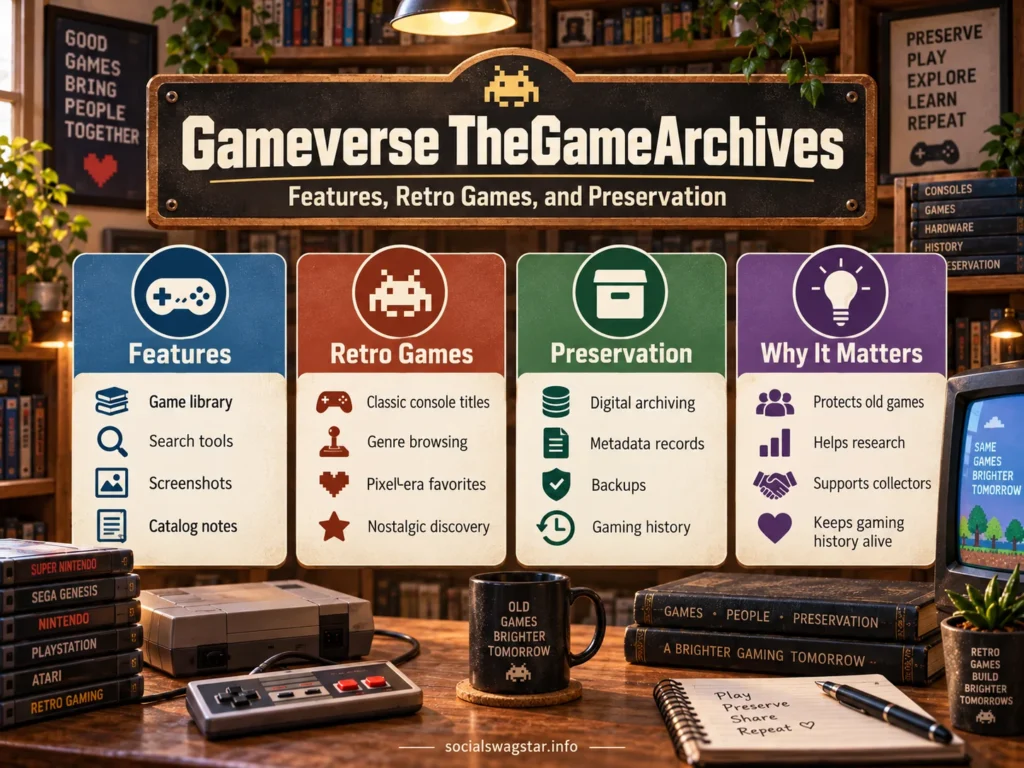
TheGameArchives’ Gameverse guides describe several functions and concepts connected with retro gaming and preservation.
Retro Game Library and Records
Older titles can become difficult to research because physical media deteriorates, hardware disappears, publishers close, and digital storefronts change.
A preservation-oriented archive therefore has value beyond simply keeping a playable copy. Records can preserve information about the platform, region, release date, publisher, language, and version. TheGameArchives says its records may organize these details alongside game files and supporting material.
Search and Filtering
A large archive is only useful when people can find what they need. The site’s Gameverse guide describes searching by title, developer, and year, along with filters for platform, file type, and language. It also discusses curated collections for categories such as particular gaming periods or regional releases. This structure can help distinguish between similarly named games or different releases of the same title.
Game Metadata and Documentation
Metadata provides context around a game rather than just storing the software itself. TheGameArchives describes fields including title, creator, release date, platform, region, format, language, and version information. Its guide also mentions manuals, box art, and release-specific notes.
For historians and collectors, those details can be important because games frequently changed between regions, platforms, and later releases.
Mods and Fan Patches
Mods can extend the life of older games. They may change graphics, fix bugs, introduce new content, improve compatibility, or make an old game easier to use on modern systems.
TheGameArchives says its Gameverse-related material covers mods, patches, compatibility information, and version requirements. It also describes unofficial files as being separated from original materials.
Emulation and Compatibility
Legacy games were built for hardware that may no longer be widely available. Emulators can reproduce aspects of older hardware environments on newer computers and devices. TheGameArchives describes Gameverse resources that may include emulator settings, controller mappings, launchers, and compatibility guidance.
That does not mean every emulator, ROM, BIOS file, or game image is automatically lawful to download or distribute. The legal position depends on what is being copied, how it was acquired, and applicable copyright rules.
Community Contributions
Preservation projects often depend on people documenting details that official publishers no longer maintain.
TheGameArchives states that contributors may provide scans, documentation, corrections, fixes, and metadata updates, while community members can report problematic files or inaccurate records. Community participation can improve an archive, but it also makes moderation and verification important.
How Game Preservation Works in Gameverse
Preserving a game means more than copying one file. A complete preservation record may include the original game build, release version, region, documentation, box art, patches, known technical requirements, and information about where the preserved copy came from.
TheGameArchives describes this type of provenance tracking as part of its approach. It says records may include upload history, source notes, version information, and integrity checks. This helps future users distinguish between an original release, modified version, fan translation, or later patch.
What Types of Games and Files May Appear?
Based on TheGameArchives’ own descriptions, Gameverse-related material may involve several kinds of content:
| Content Type | Purpose |
|---|---|
| Original game records | Document a specific title or release |
| Regional versions | Show differences between territories |
| Patches | Fix bugs or compatibility issues |
| Mods | Add or change game content |
| Fan translations | Make games accessible in other languages |
| Manuals | Preserve instructions and original documentation |
| Box art | Document physical release material |
| Emulator information | Help explain compatibility |
| Metadata | Record versions, dates, regions, and formats |
Not every record necessarily includes all of these elements, and the presence of a file does not automatically establish that redistribution is permitted.
Metadata, Checksums and File Verification
One of the more technical concepts associated with Gameverse TheGameArchives is file verification. The site’s guide says metadata records may include checksums such as MD5 or SHA-1. A checksum is a value calculated from a file. If the file changes, its calculated value will usually change too. This can help identify whether two files are identical or whether a file has been altered accidentally.
However, a matching checksum should not be treated as a complete security guarantee. It can show that a file matches a known reference, but it does not independently prove that the reference file itself is safe or legally distributable.
Mods, Patches and Fan Translations
Mods and fan-created patches are a major part of retro-gaming culture. Some projects fix bugs that were never officially addressed. Others improve controller compatibility, restore unused content, translate games into new languages, or create entirely new experiences using an older game engine. TheGameArchives describes Gameverse as supporting the documentation of these types of files and their compatibility requirements.
Users should still distinguish between original publisher content and community-created modifications. Copyright permissions can differ depending on what a patch contains and whether it redistributes copyrighted assets.
Emulation and Legacy Hardware Compatibility
Emulation is particularly valuable when original hardware is difficult to obtain or maintain.
An emulator attempts to reproduce the behavior of an older console or computer environment. However, getting a game to run correctly can involve more than installing an emulator.
- correct game version
- region
- emulator version
- controller configuration
- display settings
- patches
- system firmware
- operating-system compatibility
TheGameArchives’ own Gameverse material mentions recommended emulator settings and controller mappings as part of its compatibility guidance.
Gameverse TheGameArchives vs a Normal ROM Download Site
The intended preservation focus differs from a basic download directory.
| Gameverse / Archive Approach | Basic ROM Download Site |
|---|---|
| Emphasizes metadata | Often emphasizes the file itself |
| May document versions and regions | Documentation may be limited |
| Includes preservation context | Preservation may not be the goal |
| May include patches and manuals | Often centered on game images |
| Uses provenance/integrity concepts | Source history may be unclear |
| Discusses community documentation | Community role varies |
| Legal status still requires review | Legal status also requires review |
This does not mean that every file associated with an archive is automatically lawful or safe. The distinction is primarily about organization and preservation intent.
Copyright and Legal Considerations
Retro does not mean copyright-free. A game can be old, commercially unavailable, or difficult to purchase while still being protected by copyright.
In the United States, current Copyright Office regulations provide specific circumvention exemptions for preservation of certain video games. For example, eligible libraries, archives, and museums can perform certain preservation activities involving lawfully acquired games when defined conditions are met. Those exemptions contain limitations and do not create a general right for anyone to redistribute copyrighted games online.
The rules also distinguish institutional preservation from personal local gameplay in particular circumstances involving discontinued authentication servers. For ordinary users, the safest assumption is not that an unavailable game has automatically entered the public domain.
Safety Considerations When Using Archived Game Files
Older game files can come from many sources, and archive labels alone should not replace basic security checks.
- verifying the source
- comparing available checksums
- scanning downloaded files
- avoiding unknown executable installers
- reading community notes
- checking file extensions
- keeping operating systems updated
- using trusted emulator software
Checksums can help identify file changes, but they are only one part of verification. If a file includes an unfamiliar executable, launcher, or installer, additional caution is appropriate.
Benefits for Retro Gaming Fans
Gameverse-style preservation can be useful for several audiences. Players may discover titles they missed when they were originally released. Modders can study versions and patches. Collectors can compare regional releases. Researchers can examine game history, design decisions, manuals, and technical documentation.
The broader benefit is context. A game preserved without information about its version, platform, region, or modifications can lose part of its historical meaning. Metadata and documentation help keep that context attached to the software.
Limitations and Things to Keep in Mind
TheGameArchives makes detailed claims about Gameverse functionality on its own pages, but those claims should be understood as the site’s description of its own resources rather than independent verification of every feature.
Users should also remember that:
- archives can contain incomplete records
- community information can be wrong
- compatibility varies by system
- mods may conflict with specific releases
- file integrity does not guarantee safety
- legal availability varies by title and jurisdiction
- preservation rights are not the same as unrestricted redistribution rights
These limitations are especially important when dealing with copyrighted software.
How to Use Gameverse TheGameArchives
A practical approach is to begin with the title or platform you want to research. Search for the game, then compare available metadata such as release year, region, platform, version, and language. If patches or mods are listed, confirm which original version they require before attempting to use them.
For emulation-related material, check compatibility instructions rather than assuming one configuration works for every release. Finally, treat legal status separately from technical availability. Being able to locate a file does not automatically establish the right to download, copy, or distribute it.
Frequently Asked Questions
What is Gameverse TheGameArchives?
Gameverse TheGameArchives refers to gaming and preservation-focused resources associated with TheGameArchives. Its public guides discuss classic games, metadata, mods, patches, emulation, search tools, and community contributions.
Is Gameverse TheGameArchives only for downloading games?
No. TheGameArchives describes it more broadly as a preservation and discovery resource involving metadata, documentation, mods, compatibility information, and community contributions in addition to game-related files.
Does Gameverse support mods and patches?
TheGameArchives states that its Gameverse resources include mods, patches, compatibility details, emulator settings, and related tools.
Are retro games automatically legal to download?
No. Age or commercial unavailability alone does not automatically make a game copyright-free. Copyright status and permitted uses depend on the title, ownership, jurisdiction, and circumstances.
What is the purpose of checksums in a game archive?
Checksums help compare files and detect changes. TheGameArchives says its metadata approach can include checksum values for integrity verification.
Is emulation illegal?
Emulation itself should not be treated as automatically illegal. Legal questions usually depend on factors such as software copying, firmware, game files, circumvention, ownership, and jurisdiction. Specific preservation exemptions also exist under US copyright rules in defined circumstances.
Final Thoughts
Gameverse TheGameArchives is best understood as part of a wider retro-gaming, documentation, community, and preservation ecosystem rather than simply a place to obtain old games. Its strongest value lies in connecting game records with metadata, versions, patches, historical material, and compatibility context.
For users exploring older titles, the important distinction is between preserving gaming history and assuming every archived file is unrestricted. Technical availability, file integrity, copyright status, and safe use should always be considered separately.