Console TheGameArchives: Retro Gaming Preservation Explained
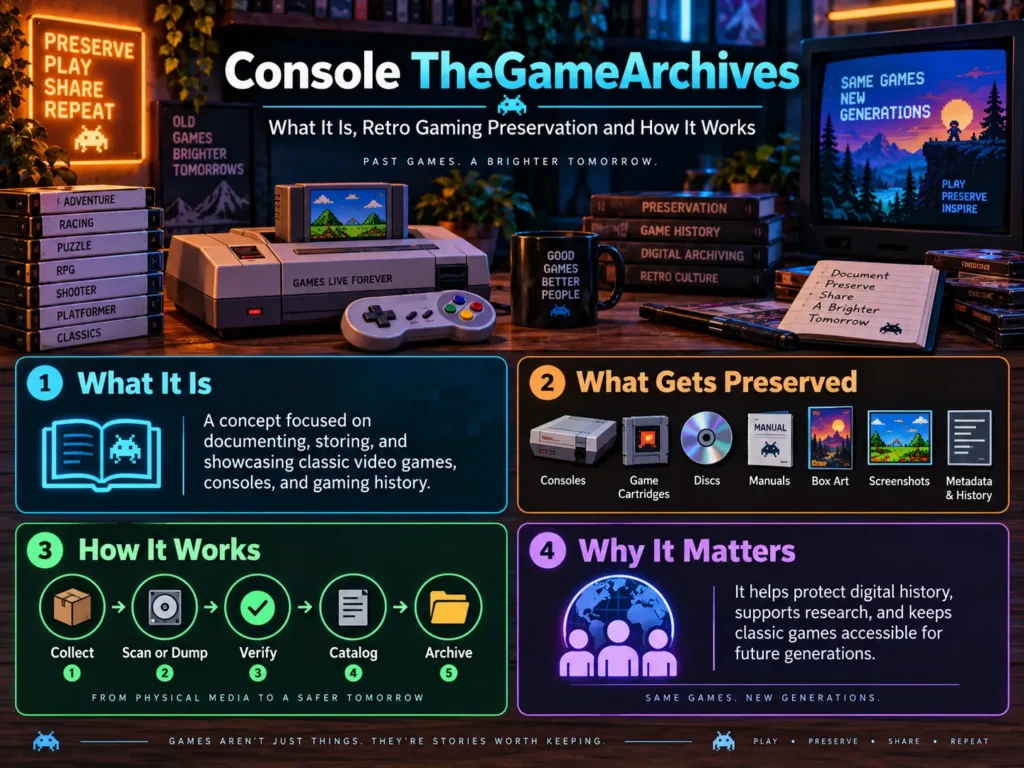
The phrase Console TheGameArchives can be confusing because TheGameArchives has used it in different ways. Some pages describe a gaming platform or console-like product, while a newer 2026 guide uses the phrase for preserving, cataloging, digitizing, and displaying retro console collections. That difference matters if you are trying to understand whether TheGameArchives is selling dedicated gaming hardware or simply publishing information about classic games, consoles, emulation, and preservation.
Console TheGameArchives is best understood from the current public evidence as gaming and retro-preservation content associated with TheGameArchives website rather than a clearly verified standalone console product. The site’s July 2026 guide focuses on cataloging physical games, protecting vintage hardware, creating verified digital copies, organizing metadata, and maintaining backups. Older pages use broader console-like product language that should be treated cautiously.
What Is Console TheGameArchives?
TheGameArchives is a gaming website with sections covering Gameverse, Console, Apps, and technology-related content. Its Console category includes guides about gaming hardware, retro collections, preservation, and other console topics.
The phrase “Console TheGameArchives” does not have one perfectly consistent definition across the site. A July 2026 article titled “Console TheGameArchives: How To Preserve, Catalog, And Display Your Retro Console Collection In 2026” clearly treats the phrase as a retro-game preservation topic. It discusses physical media, hardware storage, inventories, digital copies, checksums, and backups. That makes preservation the strongest verifiable interpretation for anyone researching the keyword today.
Is TheGameArchives an Actual Gaming Console?
This is where the available information becomes inconsistent. A November 2025 TheGameArchives article describes Console TheGameArchives almost like a commercial hardware product, mentioning an SSD, 4K and HDR support, customizable controls, backward compatibility, exclusive games, a dedicated interface, and online features.
However, the newer July 2026 page does not present a hardware specification sheet, retail product listing, manufacturer documentation, launch information, or verified console model. Instead, it focuses entirely on preservation and collecting. The site also publishes general gaming-console guides alongside TheGameArchives-branded material.
For that reason, claims that TheGameArchives is a confirmed physical console manufacturer should be treated cautiously. The public material reviewed supports the existence of the gaming website and its Console content, but it does not provide strong independent evidence for the hardware specifications described in the older article.
What TheGameArchives Says About Console Preservation
Preserving Original Consoles
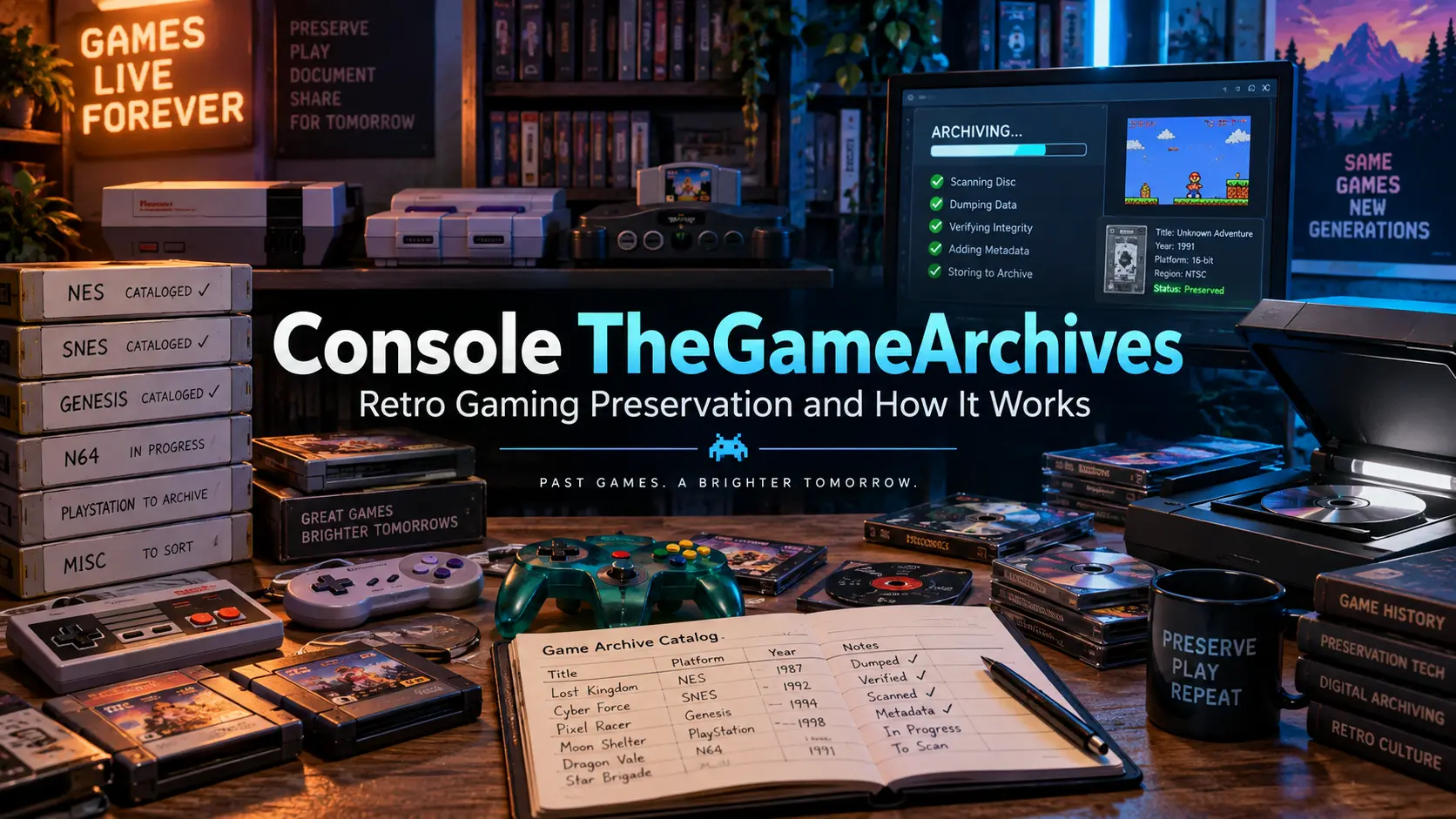
TheGameArchives recommends keeping original hardware and documenting information such as platform, region, release year, serial number, condition, and whether games include their boxes and manuals. This approach makes sense because a console archive is more useful when you preserve its context rather than collecting hardware without records.
- console name and model
- serial or revision number
- region
- purchase or acquisition date
- current condition
- controllers and cables
- original packaging
- repair history
Protecting Cartridges and Discs
Physical games deteriorate differently depending on the medium. Cartridge contacts may become dirty or corroded, while optical discs can develop scratches, warping, or other physical damage.TheGameArchives recommends safe storage, routine inspection, and careful cleaning as part of long-term preservation.
Saving Manuals, Boxes and Artwork
A complete archive should not focus only on playable code. Manuals, packaging, inserts, labels, artwork, maps, and other materials help document how a game was originally sold and experienced. The 2026 guide specifically recommends retaining contextual materials such as manuals and box art and creating high-quality scans where appropriate.
Maintaining Playable Hardware
Old consoles contain components that can fail over time. Storage conditions, dust, heat, moisture, worn connectors, aging power supplies, and internal electronic components can all affect whether original hardware remains usable. TheGameArchives recommends stable storage conditions and routine maintenance rather than simply leaving old consoles untouched for decades.
How to Catalog a Retro Console Collection
Record Console and Game Details
Start with a spreadsheet or database containing fields such as:
| Field | Example |
|---|---|
| Title | Game name |
| Platform | SNES, PlayStation, Dreamcast |
| Region | NTSC-U, PAL, NTSC-J |
| Release year | Original release date |
| Publisher | Original publisher |
| Condition | Excellent, good, damaged |
| Media | Cartridge, CD, DVD |
| Box/manual | Complete or missing |
| Notes | Repairs, revisions, or variations |
TheGameArchives recommends similar metadata, including title, platform, region, release year, publisher, serial information, and condition.
Add Region and Version Information
Different regions can contain different releases, artwork, languages, revisions, or technical characteristics. Recording region and revision information prevents two similar-looking copies from being incorrectly treated as identical.
Photograph Physical Media
Photograph the front, back, labels, packaging, discs, cartridges, and unusual markings. Images can help document condition and identify specific revisions later.
Track Condition and Accessories
Controllers, power adapters, memory cards, expansion devices, manuals, and proprietary cables are part of the history of a console. Cataloging them separately can make restoration much easier years later.
How Digital Preservation Works
Cartridge Dumping
Cartridge dumping means reading data from an original cartridge and creating a digital image of that data using suitable hardware. This can be useful for archival work, but ownership of a cartridge does not automatically grant unlimited rights to distribute its contents.
Disc Imaging
Disc imaging creates a digital representation of an optical disc. For preservation, the goal is normally to reproduce the original data accurately rather than simply copying visible files.
Metadata
Metadata is information about the archived file.
- game title
- console
- region
- revision
- source media
- dump date
- dumping hardware
- file size
- checksum
Checksums and File Verification
A checksum is a calculated value derived from a file. If the file changes because of corruption or accidental modification, its checksum usually changes as well. TheGameArchives specifically recommends storing checksum data with digital copies and performing future checksum audits to identify corruption.
Backup Copies
One copy is not an archive.TheGameArchives recommends multiple backups, including copies stored in separate locations. It also advises periodically refreshing storage and migrating files as storage technology changes.
How to Store Vintage Consoles Safely
Keep old gaming hardware in a stable environment. Avoid direct sunlight, excessive humidity, large temperature changes, dust-heavy spaces, and storage directly on floors where water damage may occur.
TheGameArchives recommends cool, dry storage, airflow around consoles, organized cable management, protective packaging for sensitive components, and limited light exposure for displayed collections. For rare equipment, documenting every repair is also useful. Replacing parts without records can make it difficult to understand what remains original.
Displaying a Retro Gaming Collection Without Damaging It
A collection can be visible without being exposed to unnecessary risk. Enclosed shelving reduces dust and accidental handling. Avoid prolonged sunlight on boxes, labels, and plastics because fading can permanently alter them.
Leave enough space for airflow if consoles are actually being powered on. Displays should also make removing a console easy. Forcing equipment through tightly packed shelving can damage connectors, packaging, or cables.
Console TheGameArchives and Emulation
What Emulation Means
An emulator is software or hardware designed to reproduce the behavior of another system closely enough to run compatible software. For example, an emulator may reproduce aspects of a discontinued console on a modern computer.
Emulator vs ROM
An emulator is the system that recreates the hardware environment. A ROM image generally refers to a digital copy of software data taken from game media such as a cartridge. Using an emulator and obtaining copyrighted game files are therefore separate questions.
Original Hardware vs Emulation
Original hardware provides the closest experience to the original device, but aging equipment can be difficult to maintain. Emulation can improve accessibility and preservation, but accuracy varies between systems and software. Serious preservation often values both: original hardware for historical authenticity and carefully documented digital copies for long-term access.
Are ROMs and Archived Games Legal?
There is no universal rule that makes every ROM download legal simply because a game is old or difficult to buy. Copyright law differs by jurisdiction, and copying, circumvention, preservation, and redistribution can be treated differently.
In the United States, current Section 1201 regulations include narrowly defined exemptions for certain discontinued video games and preservation activities. Some apply specifically to eligible libraries, archives, and museums and impose conditions on how preserved games may be accessed.
In the UK, copyright protects software and other creative works, while Section 50A of the Copyright, Designs and Patents Act permits a lawful user of a computer program to make a backup copy when necessary for lawful use. That is not the same as permission to distribute copyrighted game files publicly.
The safest approach is therefore to distinguish personal preservation from downloading or redistributing material you do not have rights to use.
Preservation vs Piracy: What Is the Difference?
Preservation is about maintaining access to historically or personally important software and hardware. Piracy generally involves unauthorized copying or distribution of copyrighted works.
The two can overlap technically; both may involve copying data, but their purpose and legal treatment can be very different. An archive should not assume that calling a file “preserved” automatically makes public distribution lawful.
How to Organize Digital Game Archives
A consistent folder structure makes a large collection easier to maintain.
| Level | Example |
|---|---|
| Platform | /PlayStation/ |
| Title | /Final Example Game/ |
| Region | /PAL/ |
| Revision | /Rev-1/ |
| Media image | game-image.bin |
| Metadata | metadata.txt |
| Checksum | checksums.txt |
| Artwork | /Scans/ |
TheGameArchives similarly recommends consistent naming, platform/title/version folders, region and revision identifiers, metadata, and checksum records.
Common Problems With Old Consoles and Game Media
Cartridge Corrosion
Dirty or oxidized contacts can prevent cartridges from reading correctly.
Disc Damage
Scratches, cracks, deterioration, and poor storage can make optical media unreadable. Battery Failure. Some cartridges use internal batteries for saved games or clock functions. These batteries eventually fail.
Aging Cables and Controllers
Cables, connectors, buttons, analog components, and power supplies can wear out even when the console itself still works.
Data Corruption
Digital archives can also degrade through drive failure, accidental modification, or unnoticed file corruption. Checksums and multiple backups reduce this risk.
What Claims About TheGameArchives Can Actually Be Verified?
| Claim | Verification Status |
|---|---|
| TheGameArchives website exists | Verified |
| The site has a Console category | Verified |
| It publishes retro-preservation guidance | Verified |
| It recommends cataloging, metadata, and checksums | Verified |
| It discusses physical media storage | Verified |
| An older page describes “Thegamearchives console” hardware | Verified as a site claim |
| Specific hardware product/specifications independently established | Not clearly verified from the public evidence reviewed |
The site itself therefore provides useful preservation material, but its older hardware-style claims should not automatically be treated as confirmed commercial product specifications.
Best Practices for Long-Term Game Preservation
- keep a detailed inventory
- photograph original items
- store manuals and packaging
- protect hardware from moisture and sunlight
- inspect cartridges and discs periodically
- document repairs
- create lawful archival copies where permitted
- record metadata
- generate checksums
- maintain more than one backup
- periodically verify archived files
Preservation works best as an ongoing process rather than a one-time backup.
Common Mistakes Collectors Should Avoid
Do not assume that every old game is copyright-free. Avoid cleaning rare media with aggressive chemicals or repairing vintage hardware without documenting what was changed. Do not keep your only digital backup on the same computer as the primary archive.
Finally, do not confuse promotional claims about a supposed console with independently verified product information. With Console TheGameArchives, that distinction is especially important because the site’s own pages use the term in different ways.
Frequently Asked Questions
What is Console TheGameArchives?
Console TheGameArchives currently appears most clearly as a retro-console preservation and gaming-information topic on TheGameArchives website. Its 2026 guide focuses on cataloging, digitization, storage, checksums, backups, and maintaining vintage hardware.
Is TheGameArchives a real physical console?
The site published a 2025 article describing a TheGameArchives console with hardware-style features, but the public evidence reviewed does not clearly establish a commercially available standalone console matching those claims.
What does a checksum do in a game archive?
A checksum creates a value based on a file’s data. Archivists can calculate it again later to check whether the stored file has changed or become corrupted.
Is using an emulator illegal?
An emulator itself and copyrighted game files are separate issues. Legal treatment depends on the emulator, how game data was obtained, what protections were bypassed, and the applicable jurisdiction.
Can I legally make backups of games I own?
Rules vary by country and circumstances. UK law includes a backup-copy provision for lawful users of computer programs when a backup is necessary for lawful use, while US preservation exemptions have specific conditions and some are limited to eligible institutions.
Why preserve old consoles if emulators exist?
Original hardware preserves physical design, controllers, timing, displays, packaging, and historical context that software emulation cannot fully reproduce. Digital preservation provides a complementary way to protect software data when old hardware or media eventually fails.
Final Thoughts
Console TheGameArchives is best approached as a retro-gaming and preservation topic rather than assuming it represents a verified physical console with established specifications. The site’s newer material provides concrete guidance on cataloging collections, protecting physical media, creating verified digital copies, and maintaining backups.
For collectors, the useful lesson is broader than one website: preserve the hardware, document the context, verify digital files, understand copyright limits, and treat unverified product claims separately from evidence-backed preservation guidance.